Size & fit
Measure your actual wrist first. The calculator uses that measurement as the minimum inner circumference, then rounds the round-bead mix up to whole beads.
Step one
Measure, don’t guess
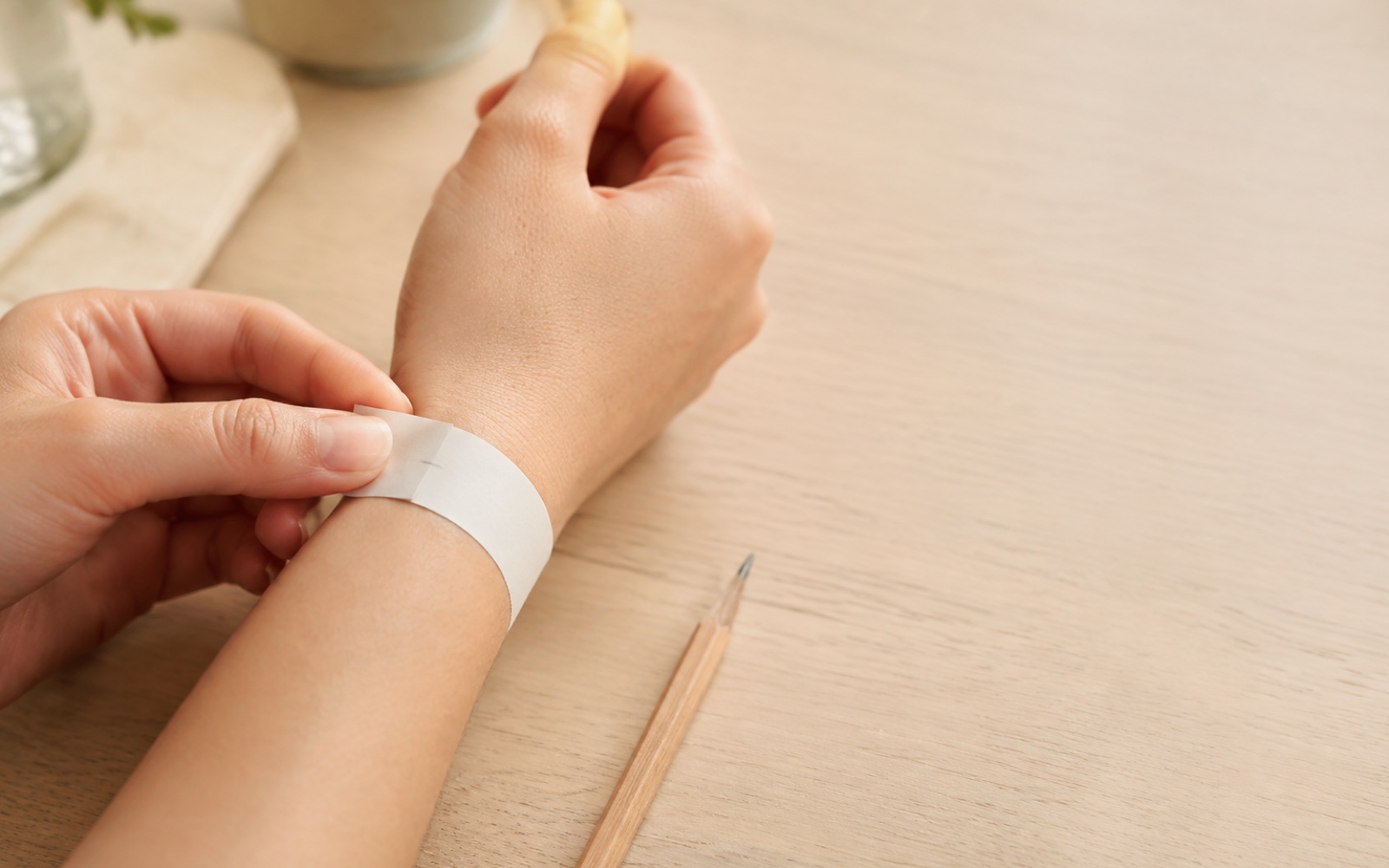
- 01
Wrap a flexible tape around your wrist where the bracelet will sit. Keep it snug without squeezing your skin.
- 02
No tape? Mark the overlap on a strip of paper or non-stretch string, lay it flat, and measure it.
- 03
Enter that exact measurement below. The calculator adds no fixed allowance; it rounds up to whole beads and shows the clearance created by that rounding.
No fixed allowance is added. The displayed clearance comes only from rounding up to whole beads or a complete pattern. A result close to 0 mm may feel tight once natural bead tolerances and cord tension are considered.
Step two
Mixed-bead calculator
Add the bead sizes in one repeating pattern. For example, two 8 mm beads and one 6 mm bead should be entered as 8 × 2 and 6 × 1.
- Pattern repeats
- —
- Total beads
- —
- Estimated inner circumference
- —
- Estimated clearance
- —
This estimate is for touching round beads on elastic cord. It uses the largest bead for the inward-radius correction and adds no fixed allowance. By default it completes as many full patterns as possible, then adds the shortest partial repeat that keeps the estimated inner circumference at or above the measured wrist. Connector or crossover beads that do not circle the wrist must be added separately.
Step three
Wearing and stacking
Bead size against wrist size
Under 15 cm wrists sit best in 6–8 mm. A 10 mm strand reads bold and visually shortens a slim wrist — it is strong on 17 cm and up.
Stack in odd numbers
Three strands with one metal spacer strand looks composed. Keep one stone family dominant and let the others support it.
Mix finish, not color
Textured black tourmaline next to polished tiger's eye reads richer than two polished browns. Contrast the surface, keep the palette tight.